By Ramachandran Rajeev Kumar — 2026-05-13
The Compartmentalisation Thesis Just Took a Hit. It Should Still Hold.
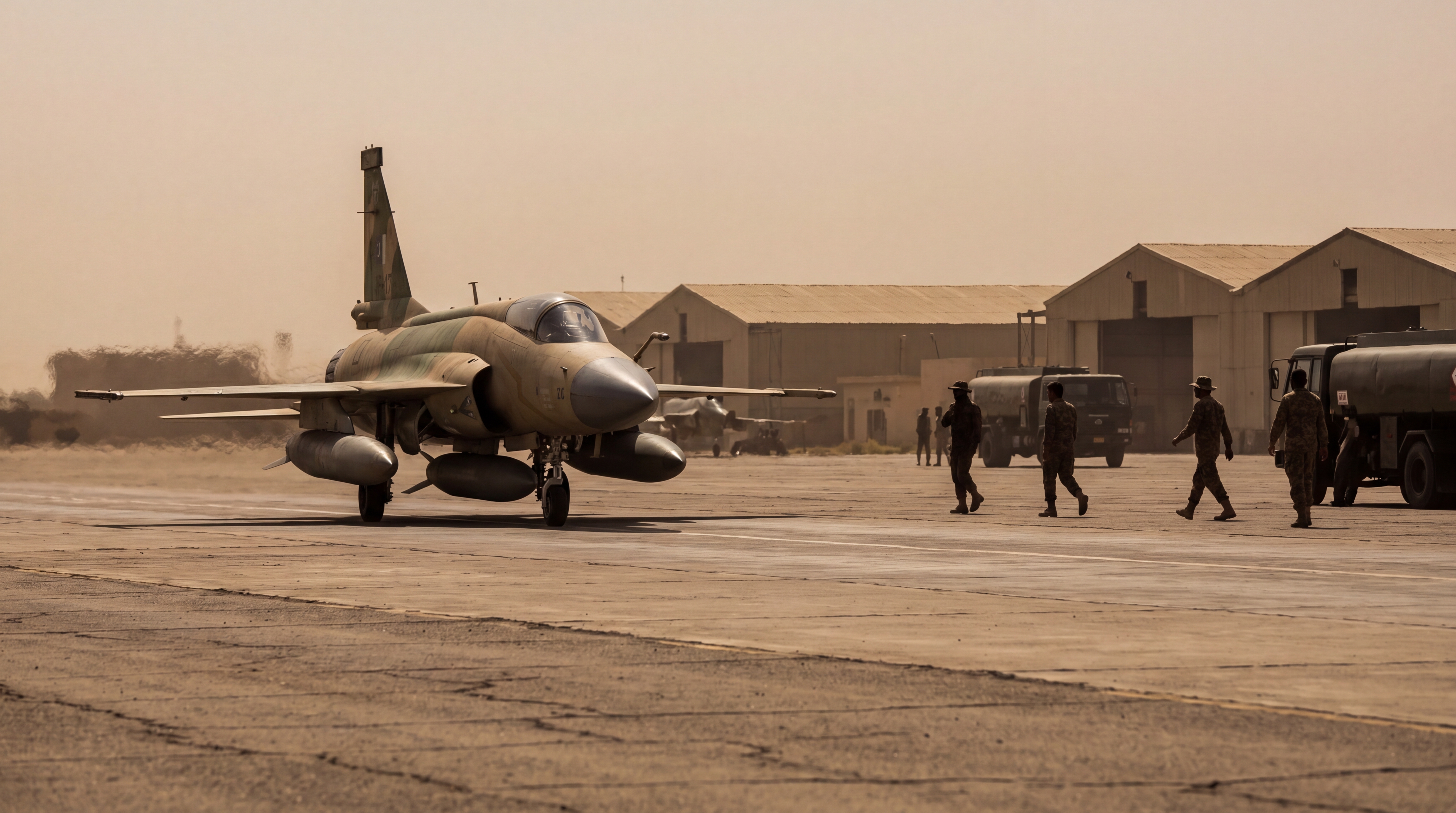
Six days ago, on 8 May, Chinese state broadcaster CCTV aired interviews with engineers from the Aviation Industry Corporation of China. The interviews confirmed, in the engineers' own words, that AVIC technical teams were physically stationed at Pakistani operational bases during the four-day India-Pakistan conflict in May 2025. Engineer Zhang Heng described the conditions: temperatures approaching fifty degrees Celsius, constant air-raid alerts, continuous fighter activity overhead.
This is the first official Chinese acknowledgement of direct technical participation in active hostilities against India. The Ministry of External Affairs responded yesterday in the language Indian foreign-policy spokesmen reserve for moments when they want to register weight without escalating: nations that consider themselves responsible should "reflect" on whether backing terrorist infrastructure affects their standing in the world.
Eight days ago, this publication argued that India's China policy had quietly become coherent. The argument was that India was running a compartmentalised approach -- hard on the boundary, calibrated on trade, patient on the multilateral file, generous on people-to-people -- and that this approach had held even through the Sindoor stress test. The AVIC admission complicates that argument. It also strengthens it. Here is why.
What the admission actually changes
The admission changes one thing of substance and several things of perception.
The substance change is small. Indian analysts who follow the open-source Chinese defence press, the Pakistani procurement record, the imagery from Pakistani bases during and after Sindoor, and the after-action commentary on the J-10CE, the PL-15, and the HQ-9P had concluded by mid-2025 that Chinese personnel had been present in operational roles. The information was not classified. It was inferred from the rhythm of refresh deliveries, the pattern of Chinese commercial flights, and the technical sophistication of certain Pakistani electronic-warfare moves during the four-day window. The intelligence community in Delhi did not need a CCTV broadcast to know.
What changes is that the inference is now an admission. The fact has moved from the analyst's notebook to the public record. That matters for diplomacy. It does not matter much for Indian strategy.
The perception change is larger. For the section of the Indian commentariat that was always uncomfortable with compartmentalisation -- visas restored, flights reopened, water-data sharing resumed, the SCO seat held -- the AVIC admission is the moment of vindication. Their argument has been that the compartmentalised approach was buying nothing real from Beijing because Beijing was, all along, actively supporting the use of force against India. The admission appears to prove the case.
It does not prove the case. It restates a known fact in louder language. The compartmentalised policy was not designed on the assumption that China would refrain from arming Pakistan. It was designed on the assumption that China would continue to arm Pakistan, would continue to support Pakistani positions in multilateral forums, would continue to expand presence in the Indian Ocean, and that India needed to keep functional channels open anyway. The AVIC admission confirms the assumption. It does not falsify the policy.
The two questions that actually matter
Compartmentalisation will be judged on two outcomes. Neither is settled yet. Both can be observed.
The first is whether the open channels are producing usable intelligence and economic leverage. Visa-issuance data tells us about Chinese commercial and academic activity in India. Flight schedules tell us about the depth of the people-to-people lane. Water-data sharing tells us about real hydrological cooperation that affects monsoon planning in Assam, Bihar, and the Northeast. The Special Representatives mechanism on the boundary tells us about whether Delhi and Beijing have a working dialogue when LAC incidents recur. If these channels are producing decisions India can use, compartmentalisation is paying for itself. If they are merely producing the appearance of normalcy, it is not.
The second is whether the closed-fist tracks are getting harder. LAC infrastructure construction in Ladakh, Uttarakhand and Arunachal. Indigenous defence production timelines. The depth of the indigenous chip ecosystem. The diversification of critical-input supply chains away from Chinese single-source. These are the metrics that tell us whether India is using compartmentalisation as a holding action while it builds, or whether compartmentalisation has become the strategy by default. If the build is happening at pace, the policy is functioning. If the build is slipping, the open channels are a concession dressed up as sophistication.
The honest answer on both questions, in May 2026, is that the data is mixed but trending in India's favour. LAC infrastructure has measurably improved. Indigenous defence production has accelerated. The chip ecosystem is now multiple lines instead of zero. The forex picture is under pressure, but India's external account discipline has held through the Iran shock better than most emerging-market peers. None of this proves compartmentalisation. But the negative case -- that India is being slowly co-opted by Chinese economic gravity while pretending otherwise -- is not visible in the numbers.
The AVIC admission as a domestic signal
The interesting question about the CCTV broadcast is not what it says about Chinese behaviour. It is what it says about Chinese domestic politics.
Beijing does not normally release this kind of detail. The AVIC engineers were paraded on state television not as a confession to India but as a heroism narrative for the Chinese audience. The implicit message was that the Pakistani performance in Sindoor -- contested but presented domestically as a Pakistani success -- was made possible by Chinese capability. This is content aimed at the Chinese taxpayer and the Chinese export market. It is meant to advertise PL-15s, J-10CEs, and HQ-9Ps to other potential buyers in the Gulf, in Africa, in Latin America. The admission is, in part, a sales pitch.
For India, the takeaway is not outrage. The takeaway is that Chinese defence-export momentum is a structural feature of the regional environment that will continue regardless of bilateral mood. Compartmentalisation, again, was designed for this world.
What the MEA response signals
The MEA statement was calibrated. It did not summon the ambassador. It did not threaten counter-action. It did not raise the temperature on the multilateral file. It registered the substance, named the problem -- backing terrorist infrastructure -- and let the volume do the rest.
Critics will read this as weakness. They are wrong. The Indian system has learned, slowly and at cost, that high-volume diplomatic reactions buy headlines and produce nothing. The visible reaction to AVIC is a one-paragraph statement. The invisible reaction sits across the Ministry of Defence, the Department of Defence Production, the Department of Telecommunications, the Department of Science and Technology, and several other agencies that will quietly accelerate selected files in the next quarterly review cycle. The visible response is theatre. The invisible response is the build.
Where this leaves the doctrine
The compartmentalised doctrine, eight days after this publication argued it was coherent, has been stress-tested by an official Chinese admission of direct combat-zone participation against India. The doctrine should still hold. The reasons are unchanged: closing the open channels would hurt Indians more than it would hurt the Chinese state, the open channels are producing usable returns, and the hard build is happening on schedule.
The honest revision is this. Compartmentalisation is the right policy for the conditions India faces. It is not the right policy for the conditions Indians might prefer to face. The wish for a cleaner moral architecture -- in which India can be functionally separated from a state that arms its adversary -- is understandable. It is not available. The map has the geography it has. The choice is between a calibrated engagement with a difficult neighbour and a performative rupture that costs Indians more than it costs Beijing. India has chosen the calibrated engagement, and the AVIC admission, for all its rhetorical heat, does not change the cost-benefit on the choice.
The policy will be judged in eighteen to twenty-four months on whether the hard build kept pace. That is the metric that matters. Not the press conferences.
The author is the founder of nBookMedia and writes on national strategy, economic policy and the Indian growth story.