By Ramachandran Rajeev Kumar — 2025-12-28
Modi's Chief Secretaries Conclave: The Human Capital Blueprint for Viksit Bharat
By Ramachandran Rajeev Kumar
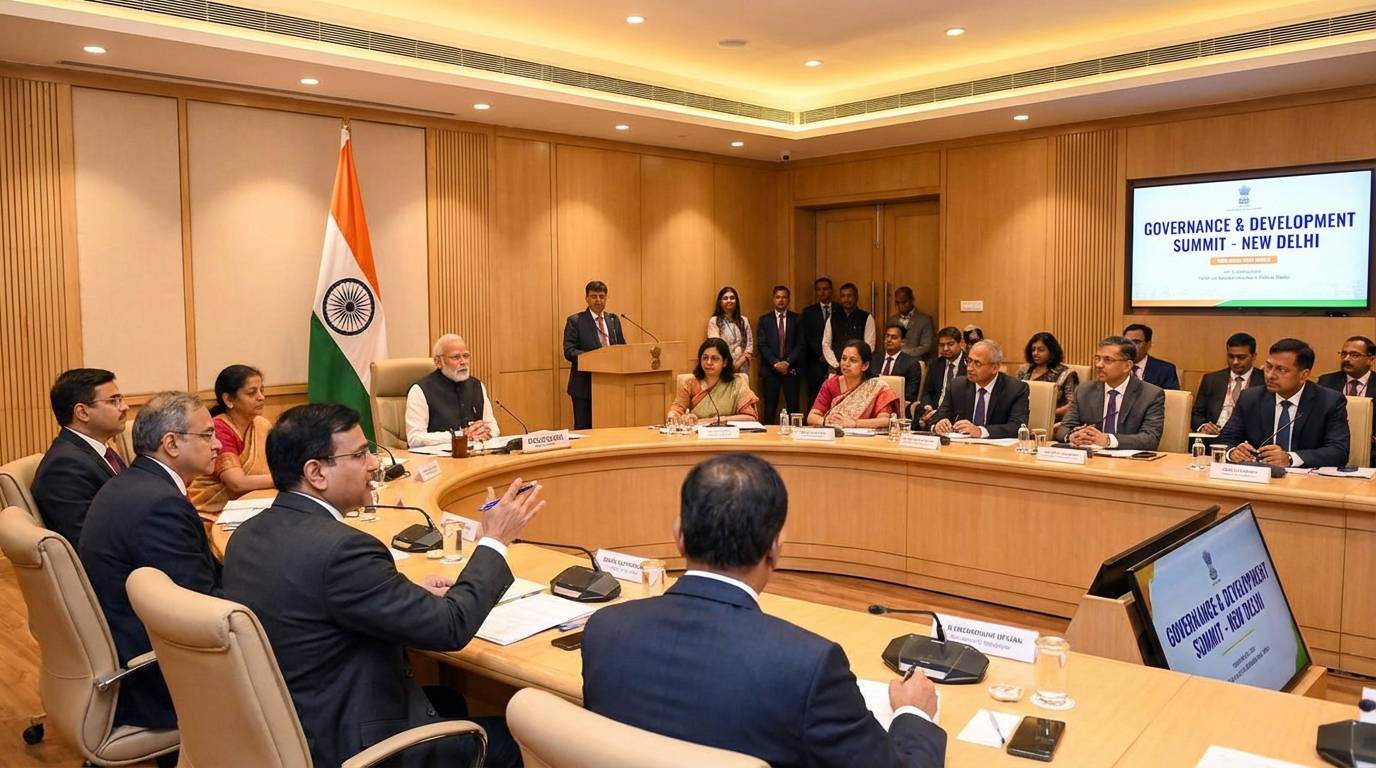
For three days this week, the most powerful bureaucrats in India gathered in Delhi for what has become an annual ritual of the Modi era: the National Conference of Chief Secretaries.
The fifth edition, held December 26-28, brought together Chief Secretaries from all 28 states and senior administrators from Union Territories. The theme this year cut to the heart of India's development challenge: Human Capital for Viksit Bharat.
Why Human Capital?
The choice of theme wasn't accidental.
India's demographic dividend, that much-celebrated window when the working-age population vastly exceeds dependents, is already open. By 2035, it will begin closing. The question isn't whether India has enough people. It's whether those people have the knowledge, skills, and capabilities to drive a $10 trillion economy.
The Prime Minister framed it directly: human capital, comprising knowledge, skills, health, and capabilities, is the fundamental driver of economic growth and social progress. Developing it requires what he called a "Whole-of-Government approach."
Translation: this isn't just the Education Ministry's problem. It's everyone's.
The Five Pillars
The conference organized its intensive deliberations around five priority areas:
1. Early Childhood Education
The foundation years (0-6) that determine cognitive development, school readiness, and lifetime earning potential. India's anganwadi system reaches millions but quality remains inconsistent.
2. Schooling
With the National Education Policy 2020 now five years into implementation, the focus shifts to execution: teacher training, curriculum updates, and learning outcomes that match global standards.
3. Skilling
India's Achilles heel. Only 2-5% of the workforce has formal skills training, compared to 75% in Germany and 96% in South Korea. The conference examined pathways to dramatically scale vocational training.
4. Higher Education
Indian universities rank poorly globally. The discussion focused on research output, industry linkages, and creating institutions that attract rather than export talent.
5. Sports and Extracurricular Activities
Often overlooked in Indian education policy, these areas received dedicated attention for their role in physical development, teamwork, and the growing sports economy.
The Sessions
Beyond the five pillars, the conference featured specialized sessions on:
Deregulation in States: Cutting red tape that stifles business and citizen services at the state level.
Technology in Governance: Opportunities and risks of AI, with the PM specifically emphasizing AI adoption and cybersecurity awareness as "pressing needs."
AgriStack for Smart Supply Chain: Using digital infrastructure to connect farmers directly to markets, reducing intermediary costs.
One State, One World-Class Tourist Destination: A push for each state to develop at least one globally competitive tourism destination.
Aatmanirbhar Bharat and Swadeshi: Making "Made in India" synonymous with quality, zero defects, and minimal environmental impact.
Post-Left-Wing Extremism Future: Planning for development in regions that have been freed from Maoist insurgency.
The Cooperative Federalism Model
What makes this conference significant is its structure, not just its content.
The traditional model of Indian governance features the Centre issuing directives and states implementing (or resisting) them. The Chief Secretaries Conference operates differently. It's designed as a collaborative forum where successful state initiatives are identified, examined, and replicated.
The PM's explicit instruction: states should share what's working, learn from each other's experiments, and commit to time-bound implementation targets.
This isn't just rhetoric. Over the past four years, the conference has driven measurable policy coordination:
- The first conference (Dharamshala, June 2022) focused on rural development
- The second (Delhi, January 2023) on ease of living
- The third (December 2023) on sustainability
- The fourth (December 2024) on infrastructure
Each has produced action items that states report progress on at subsequent meetings.
Key Directives
The PM issued several specific instructions:
Capacity Building: All states and UTs must prepare capacity-building plans in consultation with the Capacity Building Commission. This addresses a chronic weakness: Indian bureaucracy has training institutions but lacks systematic professional development.
AI in Governance: A direct push for state administrations to adopt artificial intelligence tools while building cybersecurity awareness. The subtext: the Centre is moving fast on digital transformation and states must keep pace.
Excellence Over Averages: A philosophical shift. The PM urged moving from "average outcomes to global excellence," making the Made in India label synonymous with world-class quality.
What This Means
The conference represents something important about the Modi government's approach to federalism.
Unlike previous eras where Centre-state relations were often adversarial, particularly with opposition-ruled states, the Chief Secretaries Conference creates a bureaucratic channel that operates somewhat independently of political tensions. Chief Secretaries are career civil servants who outlast political cycles. Building consensus at this level creates institutional continuity.
Whether this translates to actual improvements in education, skilling, and human capital development depends on execution. India has no shortage of plans, conferences, and initiatives. What it lacks is consistent implementation across 28 states with vastly different capacities and priorities.
The Viksit Bharat Deadline
The conference takes place against the backdrop of India's most ambitious national goal: becoming a developed nation by 2047, the centenary of independence.
That's 22 years away. The children entering anganwadis today will be 25-year-old workers in 2047. The quality of early childhood education they receive now will determine their productivity then. The students being skilled today will be mid-career professionals.
Human capital, unlike infrastructure, cannot be built quickly. A highway can be constructed in two years. A generation of well-educated, skilled workers takes twenty.
That's why this conference matters. The decisions made this week, and whether states actually implement them, will echo for decades.
The Participants
The conference brought together:
- Chief Secretaries of all 28 states
- Chief Secretaries of Delhi, Puducherry, and Jammu & Kashmir
- Senior administrators from other Union Territories
- Union Cabinet Secretary and key Central ministry officials
Approximately 36 top bureaucrats in total, representing the administrative backbone that actually runs India's government regardless of which party holds power.
Looking Ahead
The sixth National Conference of Chief Secretaries will likely be held in December 2026. By then, implementation progress on this year's human capital agenda will be measurable.
Will states have prepared capacity-building plans? Will AI adoption in governance have accelerated? Will skilling numbers show meaningful improvement?
The answers will determine whether this conference was another well-intentioned meeting or a genuine inflection point in India's development story.
For now, the blueprint exists. Execution remains the eternal Indian challenge.
The fifth National Conference of Chief Secretaries was held in New Delhi from December 26-28, 2025.