By Ramachandran Rajeev Kumar — 2026-05-01
CBAM Bites. The FTA Did Not Save Us.
Brussels gave India a trade deal worth celebrating. It also gave us a carbon bill nobody wants to pay.
On January 1, 2026, a switch flipped quietly in Brussels. The European Union's Carbon Border Adjustment Mechanism — known to trade lawyers as CBAM and to industrial exporters as a problem — exited its transitional phase and entered live financial liability.
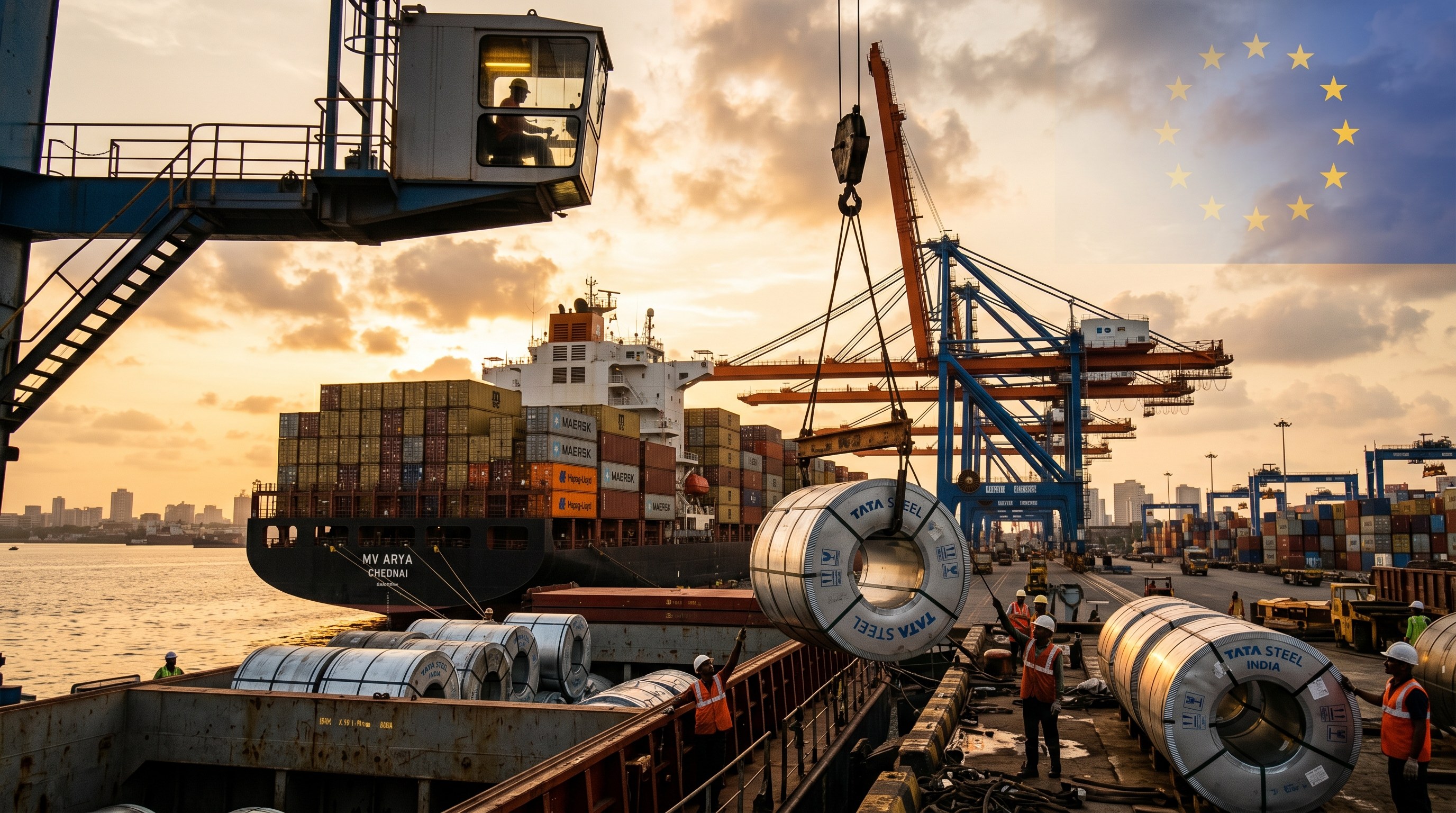
That means that as of this moment, every shipment of Indian iron, steel, aluminium, cement, fertilisers, and selected hydrogen products entering the European Union now carries an embedded carbon cost that the importer must pay, calculated on the carbon emitted to produce the goods, with the price benchmarked to the EU's own emissions trading market.
In rupee terms, the impact lands on roughly eight-point-two billion dollars of annual Indian exports. That is the value of Indian iron, steel, and aluminium products that went to the EU in 2022. The number has only grown since.
And here is the part that is harder to talk about in polite company: the EU–India Free Trade Agreement that India announced with great fanfare in February 2026 did not exempt any of it.
What the FTA actually did
The trade deal is real. It covers, by trade value, roughly ninety-nine-and-a-half percent of India's exports to the EU. It will, over time, lower most tariffs on Indian goods and open up certain Indian sectors to European services. It is the largest bilateral trade arrangement India has ever signed by some measures.
It is also, on CBAM, almost completely silent.
The provisional FTA text contains exactly one CBAM-relevant clause, and that clause is defensive: India cannot be treated worse than any other third country if the EU later grants flexibilities to anyone. That is not an exemption. That is a most-favoured-nation guarantee on a cost that nobody has yet been exempted from.
In trade-lawyer language, India has secured the right to be punished equally. That is not a victory.
Why India did not get an exemption
The honest answer is that the EU was never going to give one.
CBAM is, in Brussels' framing, an environmental measure, not a trade measure. To exempt a country from CBAM is to admit that CBAM is fundamentally a tariff in green clothing — and the EU has a treaty problem if it admits that, because the World Trade Organization rules on environmental measures are different from the rules on tariffs.
So the EU's negotiating position was: take the FTA on goods and services, leave CBAM for separate technical work. India, looking at the size of the FTA prize, took the deal.
That was a defensible call. It was not a costless one.
What CBAM actually charges
The mechanism works by requiring EU importers of covered goods to surrender CBAM certificates that match the embedded emissions of the imports they bring in. The certificate price tracks the EU Emissions Trading System carbon price, currently hovering around eighty euros per tonne of CO₂.
For Indian-made steel using coal-based blast furnaces, the embedded carbon intensity is roughly two tonnes of CO₂ per tonne of finished steel. Do the arithmetic: that is one hundred sixty euros of CBAM cost per tonne of Indian steel landing at a European port. On a tonne of finished steel that might wholesale at six hundred to nine hundred euros, the CBAM hit is fifteen to twenty-five percent of landed value.
For aluminium produced with India's coal-heavy power grid, the percentage is similar. For cement, it can be higher. These are not small numbers. They are the difference between competitive and uncompetitive in a price-sensitive commodity market.
Who absorbs the cost
In the short run, the importer pays. In the medium run, the exporter pays. In the long run, the producer transforms — or exits the market.
The Indian government's hope is that domestic decarbonisation policy can pull ahead of CBAM by giving Indian producers a credible path to lowering their own embedded carbon, so the CBAM hit shrinks as Indian production cleans up. That is the right long-term theory.
The short-term practice is brutal. Small and mid-sized Indian steel and aluminium producers do not have the capital or the time to retrofit their plants before the next shipment loads. They will lose orders. Some will lose factories.
The political question
CBAM is the cleanest example yet of a phenomenon that Indian policy thinkers have warned about for years: rich countries setting the pace of decarbonisation in ways that pass the costs to poorer producers under the brand name of climate leadership.
Brussels can argue, correctly, that EU producers also pay the carbon cost domestically through the ETS. CBAM merely levels the playing field. That argument is technically true. It is also missing the larger point. EU producers had decades and trillions of euros of accumulated capital to amortise the transition. Indian producers have neither. Asking them to pay the same carbon price now is not equality. It is a starting handicap rebranded as fairness.
The Indian Foreign Trade Policy team has been clear in private that CBAM is the priority issue for 2026 and 2027. Expect a multi-track response: WTO challenge, bilateral pressure on individual EU member states, fast-tracked domestic green steel and green hydrogen incentives, and a much louder Indian voice in the Group of Twenty climate-finance discussions.
What to watch
Three signals worth tracking over the next six months:
- First major CBAM payment — when does the first quarterly CBAM declaration come due, what is the headline number, and who pays it visibly?
- WTO action — does India formally file a CBAM dispute, or does it stay in technical consultation?
- EU sectoral expansion — CBAM is currently limited to six product categories. The EU has signalled that organic chemicals, plastics, and finished metal products are next. If those go live in 2027, India's exposure roughly doubles.
The FTA was a good deal. CBAM is a separate fight. Pretending otherwise is the kind of thing that loses the next round.
BarathVector tracks the trade and climate policy interface across India's external relationships. Subscribe for the weekly briefing.