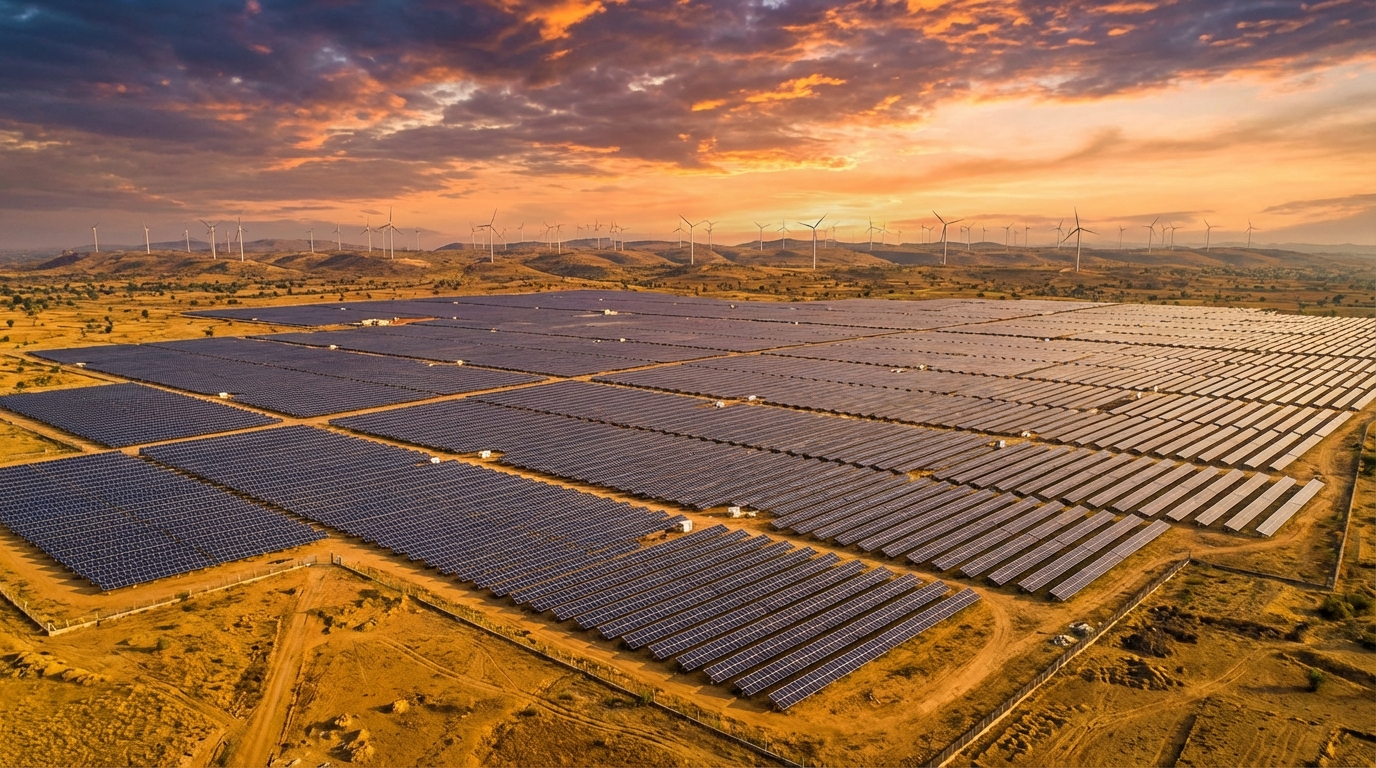
By Ramachandran Rajeev Kumar — 2025-12-20
The 1.5°C Dream is Dead. Can India Lead the 2°C Reality?
The Global Carbon Budget 2025 delivers a stark message: our carbon budget for 1.5°C is virtually exhausted. But as the world scrambles for solutions, India is quietly building something remarkable - a green economy that could define climate leadership for the next decade.
Last month, an international team of over 130 scientists released the 20th annual Global Carbon Budget report. The headline was grim: fossil fuel CO2 emissions hit another record high in 2025, reaching 38.1 billion tonnes. But buried in the data was a more urgent story - the remaining carbon budget to limit warming to 1.5°C is now just 170 billion tonnes.
At current emission rates, that's four years.
The Numbers That Changed Everything
The Global Carbon Budget 2025 paints a picture of a planet running out of atmospheric space:
| Metric | 2025 Value | What It Means |
|---|---|---|
| Fossil Fuel CO2 | 38.1 Gt | Record high, +1.1% from 2024 |
| Total CO2 Emissions | 42.2 Gt | Effectively tied with 2024 record |
| Atmospheric CO2 | 425.7 ppm | 52% above pre-industrial levels |
| 1.5°C Budget Remaining | 170 Gt | ~4 years at current rates |
| 2°C Budget Remaining | 1,055 Gt | ~25 years at current rates |
The 1.5°C target - the aspirational goal of the Paris Agreement - is mathematically dead unless we see emission reductions at a scale never achieved in human history. The 2°C target, our fallback, gives us roughly 25 years.
But here's the counterintuitive finding: 35 countries have now decoupled emissions from economic growth - twice as many as a decade ago. Progress, while fragile, is possible.
India's Green Transformation: By the Numbers
While global emissions keep rising, something remarkable is happening in India. The country is executing what may be the most ambitious energy transition in history - not through degrowth, but through aggressive green industrialization.
Renewable Energy: The 500 GW Sprint
India's renewable energy journey reads like a startup success story:
| Year | Renewable Capacity | Growth |
|---|---|---|
| 2014 | 76.37 GW | Baseline |
| 2025 | 233.99 GW | +207% (3x growth) |
| 2030 Target | 500 GW | Requires 50 GW/year |
In the first half of 2025 alone, India added 22 GW of renewable capacity - a 56% increase year-over-year. This surge pushed clean energy sources (including large hydro and nuclear) above 50% of total power capacity for the first time in India's history.
Solar manufacturing has scaled even faster: from 2.3 GW production capacity in 2014 to 78 GW by March 2025 - a 34x increase. Under the Production Linked Incentive (PLI) scheme, 48 GW of new module manufacturing has been awarded, with 25 GW of solar cell production and 2 GW of wafer production now operational.
Electric Vehicles: From Laggard to Leader
India's EV transformation is accelerating:
- 2020: EV penetration below 1%
- 2024: 130,000 battery EVs produced
- 2025: 377,000 battery EVs projected (nearly 3x growth)
- 2025 (Jan-May): 0.9 million EVs sold (8% market share)
The FAME III scheme, launched with ₹15,000 crore ($1.8 billion) for 2025-30, is specifically targeting tier-2 and tier-3 cities - bringing clean mobility beyond metro centers.
Green Hydrogen: The Next Frontier
Last week, Union Minister Prahlad Joshi test-drove a Toyota Mirai fuel cell vehicle in Delhi - a signal that India is serious about hydrogen mobility. The green hydrogen market is projected to grow from $9 billion in 2024 to $34 billion by 2030, driven by the National Green Hydrogen Mission's subsidies and carbon credit incentives.
The Carbon Market Credibility Question
Here's where it gets interesting - and complicated.
India is building one of the world's most ambitious domestic carbon markets. The Indian Carbon Market (ICM) portal launches in January 2026, creating a centralized platform for carbon credit creation, registration, and trading. By some estimates, the Indian carbon credit market could exceed $10 billion by 2030, with 250 million credits traded domestically in 2025 alone.
But credibility is everything in carbon markets. And India faces three critical tests:
Test 1: Verification Systems
On March 28, 2025, the Ministry of Power approved 8 crediting methodologies for voluntary carbon credits. On October 8, the Ministry of Environment notified emission intensity targets for aluminium, cement, chlor-alkali, and pulp & paper sectors - covering 282 entities.
The transition from the Perform, Achieve, and Trade (PAT) scheme to the new Carbon Credit Trading Scheme (CCTS) is underway. But unlike many Emissions Trading Systems (ETS) globally, India's CCTS lacks a dedicated pilot phase - a feature that typically allows early market imperfections to be addressed before full-scale operations.
This is high stakes. If verification fails, India's carbon credits become worthless on international markets.
Test 2: Integration with Global Markets
Article 6 of the Paris Agreement creates a framework for international carbon trading. India's ability to seamlessly integrate with global carbon markets - particularly the CORSIA aviation offset program and the EU's Carbon Border Adjustment Mechanism (CBAM) - will determine whether Indian credits command premium prices or trade at discounts.
A transparent, well-functioning carbon market could attract significant foreign direct investment (FDI) and green technology transfer. A market perceived as opaque or unreliable will be bypassed.
Test 3: Enforcement
Having rules is one thing. Enforcing them is another.
The coming years will test whether India can hold 282 large emitters accountable, manage a diverse market that spans energy-intensive industries to MSMEs, and maintain data integrity across millions of transactions.
The Credibility Dividend
If India gets this right, the payoff is enormous.
Investment flows: India is already attracting US$40 billion in EV manufacturing investment through 2030, with $27 billion for battery production. A credible carbon market unlocks additional green finance - potentially hundreds of billions in climate-aligned investment.
Export competitiveness: As the EU's CBAM comes into force, Indian manufacturers with verified low-carbon footprints gain competitive advantage. Those without face de facto tariffs.
Climate leadership: At COP31 in 2026 (likely hosted in South America), India could position itself as the template for emerging market climate action - not through sacrifice, but through green industrialization.
What the Carbon Budget Tells Us About Strategy
The Global Carbon Budget 2025 identifies where emissions are rising and falling:
| Region | 2025 Emissions Change | Trend |
|---|---|---|
| China | +0.4% | Modest growth |
| India | +1.4% | Modest growth |
| United States | +1.9% | Reversing recent declines |
| European Union | +0.4% | Modest growth |
| Japan | -2.2% | Declining |
| International Aviation | +6.8% | Exceeding pre-COVID |
India's +1.4% growth seems alarming until you consider context: India is growing its economy at 6-7% annually while keeping emissions growth to 1.4%. This is exactly the decoupling that 35 countries have achieved - and that the remaining 160+ have not.
The question isn't whether India's emissions are growing. It's whether India is building the infrastructure for eventual net-zero.
On that metric, the data is compelling: 500 GW renewable target, $360 billion clean energy investment planned by 2030, 78 GW solar manufacturing capacity, and a domestic carbon market targeting $10 billion in value.
The Path Forward
The 1.5°C dream may be dead, but the 2°C reality is still achievable - with 25 years of carbon budget remaining. That timeline demands three things:
1. Accelerate Domestic Deployment
India must continue adding 50 GW of renewable capacity annually to hit its 500 GW target. The first half of 2025 saw 22 GW added - a pace that, if sustained, exceeds requirements.
2. Build Market Credibility
The January 2026 ICM portal launch is a defining moment. India must demonstrate:
- Transparent registry systems
- Independent verification
- Real-time emissions monitoring
- Enforcement against non-compliance
Get this right, and India becomes Asia's carbon finance hub. Get it wrong, and Indian credits trade at discount to European or American equivalents.
3. Export Green
India's manufacturing ambitions aren't just domestic. The FTA revolution (UK, UAE, Oman) is opening export markets precisely as global demand for verified low-carbon products surges.
By 2030, "Made in India" should be synonymous with "Made Green" - and India's carbon market should be the verification backbone that makes that claim credible.
The Bottom Line
The Global Carbon Budget 2025 is not a death sentence. It's a deadline.
For India, the next five years represent an extraordinary opportunity: to build the world's third-largest economy on a foundation of renewable energy, electric mobility, and credible carbon markets. To prove that developing nations can industrialize without the carbon intensity of the 20th century model.
The 1.5°C target may be beyond reach. But India's choices in 2025 and 2026 - on carbon market design, verification systems, and renewable deployment - will determine whether 2°C is a tragedy we drift into or a challenge we deliberately navigate.
The carbon budget is almost spent. India's green credibility budget is just being built.