By Ramachandran Rajeev Kumar — 2026-01-02
The Burden of Books: 68% of Indian Children Face Spinal Damage from Heavy School Bags
By Ramachandran Rajeev Kumar
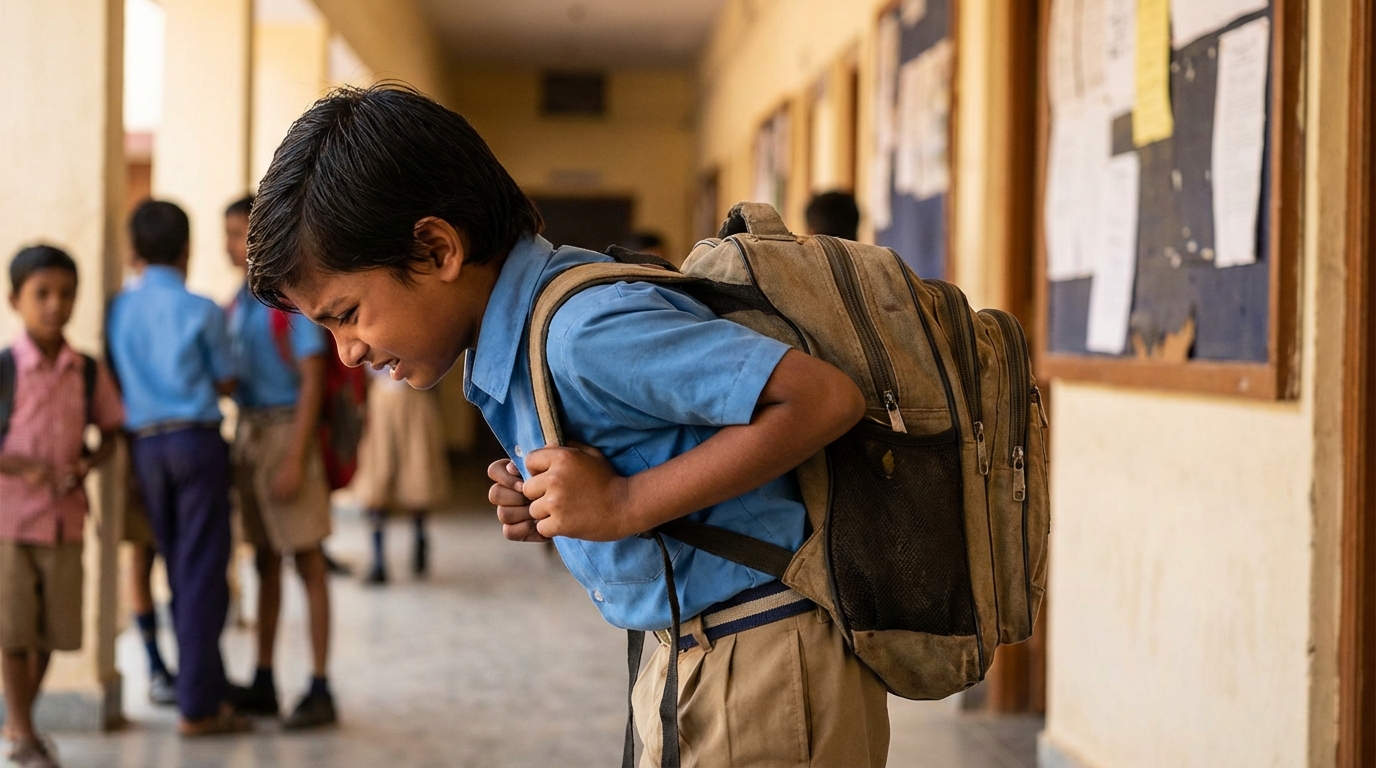
Every morning, across India, roughly 250 million school children strap on backpacks that are slowly destroying their spines. Not figuratively. Literally.
A 2016 ASSOCHAM survey found that 68 percent of children under the age of 13 across India are experiencing serious spinal damage and irreversible back problems. A more recent study from Central India found that 56 percent of students experienced musculoskeletal pain in the past 12 months, with over 21 percent requiring medical attention.
This is not a future crisis. It is happening right now, in every school, in every city and village, to children whose bodies are still growing.
The 10% Rule Everyone Ignores
India has a policy. The Ministry of Education's School Bag Policy 2020, aligned with the National Education Policy, is crystal clear: school bags should weigh no more than 10 percent of a child's body weight.
For a typical 7-year-old weighing 22 kg, that means a bag of 2.2 kg maximum.
The reality? Studies from Pune and Hyderabad found that 77 percent of students carry bags exceeding the safe limit. Research from Central India recorded average bag weights at 16.5 percent of body weight - nearly double the recommended limit. Some children lug bags weighing 20-30 percent of their body weight, five days a week, for years.
| Child's Weight | Safe Bag Weight | Typical Actual Weight |
|---|---|---|
| 20 kg | 2.0 kg | 4-6 kg |
| 25 kg | 2.5 kg | 5-7 kg |
| 30 kg | 3.0 kg | 6-9 kg |
The math is brutal. The enforcement is non-existent.
What Heavy Bags Do to Growing Spines
Children are not small adults. Their musculoskeletal systems are developing, their bones are still forming, their spines are vulnerable. When you force a child to carry excessive weight day after day, the consequences are medical, not merely inconvenient.
Immediate effects:
- Forward head posture to compensate for the backward pull
- Rounded shoulders from strap pressure
- Lower back strain from spinal compression
- Muscle fatigue and chronic pain
Long-term damage:
- Scoliosis - sideways curvature of the spine
- Kyphosis - exaggerated forward rounding of the upper back
- Degenerative disc disease - early breakdown of spinal discs
- Permanent postural deformities that persist into adulthood
- Early-onset arthritis in the spine and joints
The spine leans to compensate for asymmetric weight distribution, creating stress on the middle back, lower back, and ribs. This muscle imbalance leads to spasms, chronic pain, and in severe cases, permanent vertebral damage.
These are not hypothetical risks. They are documented, peer-reviewed medical realities affecting millions of Indian children.
The Policy-Reality Gap
India does not lack policy. It lacks execution.
The 1993 Yashpal Committee report, "Learning Without Burden," warned about heavy school bags three decades ago. The Kendriya Vidyalaya Sangathan piloted a "load shedding" policy in 2010. The School Bag Policy 2020 set clear guidelines. Multiple state governments - Maharashtra, Tamil Nadu, Delhi - have issued directives.
And yet, in January 2025, schools that actually monitor bag weights report that most students still carry disproportionate loads.
What the policy recommends:
- Only 2 books for Classes I-II (Language and Math)
- Only 3 books for Classes III-V
- Block periods to reduce daily book requirements
- Single notebooks kept at school, one at home
- No homework until Class II
- Digital weighing machines in every school
- 10 bagless days per year
What actually happens:
- Schools send home 6-8 books daily
- Multiple notebooks for each subject
- Heavy homework from kindergarten onwards
- No weighing machines
- Bagless days treated as optional holidays
The gap between policy and practice is not a mystery. It is a choice - made by schools prioritizing syllabus completion over child health, by parents who measure education in kilograms of books, and by a system that monitors exam scores but not spinal curvature.
What Other Countries Do Differently
The 10 percent rule is not uniquely Indian. It is the global consensus, used across Europe, North America, and parts of Asia. The difference lies in implementation.
Germany and the Netherlands: Schools have lockers. Children store books at school and carry only what they need for homework. The concept of lugging every textbook daily is foreign.
Finland: Minimal homework, digital-first curriculum, and a philosophy that trusts teachers to cover material without requiring children to carry entire libraries. Lockers are standard.
Japan: Children use randoseru - structured leather backpacks designed for durability and ergonomics. But critically, they walk to neighborhood schools (reducing commute time) and the curriculum is designed around what can reasonably be carried.
United States and Canada: Lockers are universal in schools. The 15 percent body weight guideline is widely taught to parents. Schools face liability concerns if children are injured.
India: No lockers. Long commutes. Competitive curriculum requiring multiple textbooks daily. Zero accountability for schools that overload children.
The solution is not rocket science. Other countries solved this decades ago.
The Digital Promise, Mostly Unfulfilled
The NEP 2020 envisions a digital future where heavy textbooks become obsolete. The infrastructure exists - at least on paper.
DIKSHA: A national platform with digital content, QR codes embedded in NCERT textbooks, interactive resources. In theory, a student could scan a page and access videos, exercises, and notes without carrying the physical book.
ePathshala: NCERT's repository of e-textbooks, audio-visual content, and supplementary materials.
PM e-VIDYA: A unified platform for digital, online, and broadcast education reaching 25 crore students.
Free Tablet Schemes: Multiple states distributing tablets to students, with preloaded educational apps and e-books.
The technology is ready. The adoption is not.
Most schools still require physical textbooks. Most teachers still assign homework that requires notebooks. Most parents still believe that "proper education" means a bag full of books. The QR codes in NCERT textbooks are scanned by a tiny fraction of students.
Digital transformation in education has been talked about since the 1990s. Three decades later, children's spines are still paying the price for our collective inertia.
What Needs to Change
The path forward is not complicated. It requires will, not innovation.
For the Government:
- Mandatory enforcement of the 10% rule with penalties for non-compliant schools
- Annual health audits including posture and spine checks
- Locker infrastructure as a requirement for school recognition
- Accelerated digital adoption with subsidized tablets for all government school students
- Curriculum redesign that reduces daily book requirements
For Schools:
- Install weighing machines and actually use them
- Implement block scheduling to reduce daily subjects
- Store workbooks and reference materials in classrooms
- Embrace digital resources instead of treating them as supplements
- Redesign homework to not require carrying books home
For Parents:
- Weigh your child's bag - today
- If it exceeds 10% of body weight, intervene
- Push back on schools that overload
- Invest in ergonomic bags with proper support
- Watch for signs of pain, fatigue, or postural changes
For Students:
- Pack only what is needed for the day
- Use both shoulder straps (never one-shoulder carry)
- Report back pain to parents and teachers
- Use digital resources when available
The Stakes
This is not about convenience. It is about whether we are willing to physically damage an entire generation of children in the name of education.
A child with chronic back pain cannot concentrate in class. A teenager with scoliosis carries that deformity for life. An adult with degenerative disc disease at 30 faces decades of reduced mobility and quality of life.
We test children relentlessly on their academic knowledge. We measure schools by board exam results. We rank students by marks obtained.
Perhaps it is time to also measure how many children we sent home with intact spines.
The Bottom Line
68 percent of Indian children under 13 already have spinal damage.
That number will not decrease on its own. Policy documents will not lighten school bags. Digital platforms will not matter if no one uses them.
This requires action - from governments that enforce their own rules, from schools that prioritize health over syllabus, from parents who question why their 8-year-old carries a 7-kg bag.
The burden of books is a choice. We can choose differently.
The author believes that education should build minds, not break backs.