By Ramachandran Rajeev Kumar — 2026-02-04
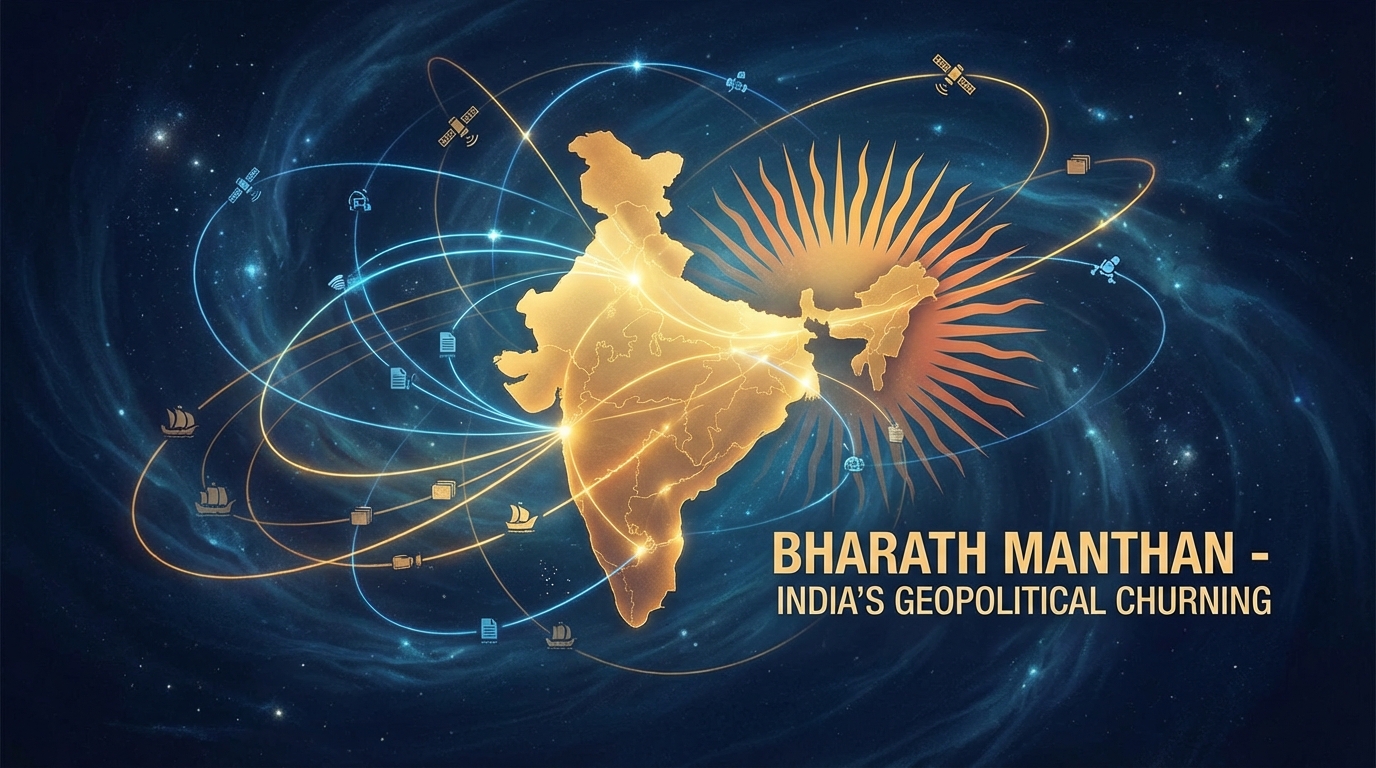
Bharath Manthan: India's Geopolitical Decade (2026-2036)
A comprehensive analysis of the forces that will shape India's rise as a global power
By BarathVector Editorial | February 4, 2026
The Inflection Point
In the ancient tale of Samudra Manthan, gods and demons churned the cosmic ocean for a thousand years, releasing both poison and nectar. India today stands at a similar churning—a civilizational inflection point where the forces of opportunity and challenge collide with unprecedented intensity.
Having surpassed Japan to become the world's fourth-largest economy in April 2025, India now gazes at Germany in the rear-view mirror, with projections placing it as the third-largest economy by 2027-28. The demographic dividend peaks around 2030-2036. The nuclear triad achieved operational credibility. UPI processes more daily transactions than Visa globally. And yet, 69% of jobs face automation risk, 90% of workers remain in the informal sector, and the neighborhood increasingly tilts toward Beijing.
The next decade will determine whether India emerges as a genuine pole in the multipolar world or remains a large but peripheral player. This is the Bharath Manthan—the great churning of our times.
I. The Economic Ascent: Third Largest by 2028
The numbers tell a story of relentless momentum. India's GDP reached USD 4.18 trillion in April 2025, and the IMF projects 7.3% growth for FY26—the fastest among G20 economies. S&P Global's upgrade to 'BBB' marks the first sovereign rating improvement in 18 years.
The manufacturing renaissance, long promised, is finally materializing. The Production Linked Incentive schemes have attracted INR 2 lakh crore in investment, generated INR 18.7 lakh crore in production, and created 12.6 lakh jobs. Electronics production surged 147% from FY21 to FY25. Solar module manufacturing capacity doubled to 74 GW in a single year.
The China+1 strategy has positioned India as the primary beneficiary of supply chain diversification. FDI reached USD 81 billion in FY 2024-25, with manufacturing FDI up 18% year-on-year. The Tata-PSMC semiconductor fab in Dholera—a USD 11 billion investment—will begin production in December 2026, marking India's entry into chip fabrication.
Yet the economic story has shadows. Private sector capex is projected to decline 25.5% in FY26. Wealth inequality remains stark—the top 1% hold 40% of national wealth while the bottom 50% hold just 3%. Most critically, the economy must generate 78.5 lakh non-farm jobs annually through 2030 to absorb the workforce surge. Current trends fall short.
The path to a $10 trillion economy by 2035 exists. Walking it requires not just growth but transformation—of employment patterns, skill systems, and the very nature of Indian enterprise.
II. Strategic Autonomy: The Tightrope Walk
India's foreign policy doctrine faces its most severe stress test since independence. The May 2025 India-Pakistan conflict—Operation Sindoor—killed over 50 and brought the subcontinent to the brink. Trump's 50% tariffs on Indian goods, imposed in retaliation for Russian oil purchases, fractured the assumption that economic ties insulate strategic differences. The Bangladesh crisis, with Hasina's ouster and rising anti-India sentiment, exposed vulnerabilities in the immediate neighborhood.
The traditional formulation of "strategic autonomy"—maintaining equidistance from great powers—is proving inadequate. As Foreign Policy observed, India lacks "strategic indispensability" to any major power, leaving it vulnerable to pressure from all sides.
The Quad intensifies despite political turbulence. Malabar 2025 exercises proceeded in Guam even as Trump branded India a "bad actor" for its Russia ties. The NDAA for FY2026 underscores expanded US-India defense cooperation. Yet India simultaneously attended the SCO summit in Tianjin—Modi's first China visit in seven years—and hosted Putin in December 2025, reaffirming the $100 billion bilateral trade target.
This is not confusion but calculation. India's "plurilateral omni-alignment" seeks to extract benefits from multiple platforms without being captured by any. The question is whether this sophisticated balancing act can survive an era of sharpening great power competition.
The UNSC permanent seat remains the great prize—and the great frustration. India has support from four of five permanent members, but China's veto looms eternal. The path forward runs through coalition-building among Global South nations, a strategy India will advance through its 2026 BRICS presidency.
III. The Neighborhood Calculus: Losing Ground to Beijing
The uncomfortable truth: India is losing its neighborhood to China—not through military conquest but through infrastructure investment.
Consider the ledger. Pakistan, Sri Lanka, Bangladesh, Nepal, and the Maldives are all Belt and Road Initiative members. Chinese debt comprises over 50% of Sri Lanka's bilateral obligations, 25% of Bangladesh's, and two-thirds of the Maldives'. Only Bhutan remains outside Beijing's embrace.
The Bangladesh rupture is particularly painful. Sheikh Hasina, India's closest regional ally, fled to India after her August 2024 ouster. The interim government under Muhammad Yunus has pivoted sharply—resuming direct trade and flights with Pakistan after 53 years, accepting $2.1 billion in Chinese investments, and offering the Lalmonirhat airport (20 km from the Indian border) to China. The February 2026 elections may determine whether this shift becomes permanent.
With Sri Lanka, the competition crystallizes around ports. China holds a 99-year lease on Hambantota; India's Adani group operates the Colombo West International Container Terminal with $553 million in US financing. The island will play both powers against each other indefinitely.
The China border itself has achieved an uneasy stability. The October 2024 disengagement at Depsang and Demchok—the last friction points from the 2020 Galwan crisis—survived the India-Pakistan conflict. Trade, flights, and the Kailash-Mansarovar yatra have resumed. But 50,000 troops remain deployed on both sides, and China builds "dual-use" villages along the LAC while India constructs the Zojila tunnel and Mudh-Nyoma airbase.
The most unexpected development: India's rapprochement with the Taliban. The October 2025 Jaishankar-Muttaqi meeting in New Delhi, and India's subsequent upgrade of its Kabul mission to embassy status, reflects pragmatic calculation. Taliban-Pakistan tensions over the Durand Line and TTP sanctuaries make Kabul a potential counterweight to Islamabad. India is now Afghanistan's largest humanitarian donor, with more FDI than China, Iran, or Pakistan.
IV. Defense and Deterrence: Combat-Validated
Operation Sindoor was a validation event. BrahMos missiles struck targets in Pakistan. The S-400 intercepted incoming drones and missiles. The indigenous Long-Range Hypersonic Missile—tested in November 2024 at Mach 5-10 with 1,500 km range—entered serial production. India demonstrated capabilities that had previously existed only in specifications.
The defense budget trajectory reflects sustained commitment: INR 7.85 lakh crore for FY 2026-27, up 15.2% year-on-year, with cumulative spending of $543 billion projected through 2030. Indigenous production now accounts for 75% of defense procurement, with targets reaching 90% by decade's end.
The nuclear triad achieved operational credibility with the December 2025 K-4 missile launch from INS Arighat. The submarine-launched ballistic missile, with 3,500+ km range and 100-meter CEP, validates India's second-strike capability. With INS Arihant already operational and INS Aridhaman commissioning in early 2026, India can maintain continuous at-sea deterrence.
The acquisition pipeline is substantial: 26 Rafale-M jets for the Navy ($7.6 billion), potentially 114 additional Rafales for the Air Force ($39 billion), six Project 75I submarines ($11-12 billion), and the nuclear-propelled INS Vishal carrier in the 15-year roadmap.
In space, India has demonstrated ASAT capability (Mission Shakti, 2019), launched the world's first commercial space surveillance satellite (SCOT, March 2025), and approved INR 27,000 crore for 52 military satellites by 2029. The Defence Space Agency is expanding rapidly.
Defense exports have surged from negligible to $3.2 billion, with BrahMos missiles now operational in the Philippines and new orders from Vietnam and Indonesia. Combat validation from Operation Sindoor has generated a surge of regional inquiries.
The Indian Ocean remains the strategic priority. The MAHASAGAR initiative integrates Global South nations into India's maritime strategy. Three major events in Visakhapatnam (February 2026)—the International Fleet Review, MILAN exercises, and IONS Conclave—will showcase India's blue-water ambitions. But China maintains 7-8 warships continuously in Indian Ocean waters, with Hambantota, Kyaukphyu, and other dual-use facilities expanding Beijing's presence.
V. Technology Sovereignty: The $25 Billion Bet
India is executing the most ambitious technology sovereignty campaign since independence, with over $25 billion committed across semiconductors, AI, space, quantum computing, and digital infrastructure.
The semiconductor push is pragmatic rather than revolutionary. The Tata-PSMC fab in Dholera will produce mature-node chips (28nm+) for automotive and industrial applications—not cutting-edge processors, but products where domestic demand is growing. The strategy emphasizes back-end (assembly, test, packaging) rather than leading-edge fabrication, which requires $20+ billion per facility.
The IndiaAI Mission has exceeded expectations, deploying 38,000 GPUs (including NVIDIA H100s and Google Trillium TPUs) against an initial 10,000 target. Subsidized compute at INR 65/hour (versus AWS's INR 330+) democratizes AI development. The February 2026 IndiaAI Impact Summit in New Delhi positions India as the Global South's AI convener.
Gaganyaan approaches its moment. The uncrewed G1 mission launches in March 2026 with the Vyommitra humanoid robot; the crewed mission follows in 2027. ISRO has launched 434 foreign satellites for 36 countries, generating $439 million in revenue, with the United States as the largest customer.
The National Quantum Mission has allocated INR 6,000 crore for an eight-year program targeting 50-1000 physical qubits. India's first significant quantum computer—QpiAI-Indus at 25 qubits—launched in April 2025, with plans for local hardware manufacturing in 2026.
But the crown jewel is digital public infrastructure. UPI processes 50% of global digital transactions—640 million daily, surpassing Visa's 639 million. The system is live in Singapore, UAE, France, Cyprus, and other nations, with 20+ countries targeted by 2028-29. Project Nexus, launching in 2026, will connect India, Malaysia, Philippines, Singapore, and Thailand in a multilateral instant payment network serving 1.7 billion people.
India is not just building technology—it is exporting development models. Peru, Namibia, and Trinidad & Tobago are developing UPI-inspired payment systems with Indian collaboration. This is soft power through infrastructure.
VI. The Energy Transition: Contradictions and Commitments
India achieved its 50% non-fossil electricity capacity target in June 2025—five years ahead of the NDC commitment. Total installed capacity crossed 505 GW in October 2025, with renewables at 259 GW. FY25 saw record additions of 29.52 GW in clean energy.
The 500 GW non-fossil target by 2030 appears achievable. Solar capacity exceeds 100 GW. Wind is at 52.68 GW with a 99.9 GW target for 2029-30. Investment requirements are massive—$360 billion by 2030—but the trajectory is clear.
The Budget 2026 Nuclear Energy Mission—INR 20,000 crore targeting 100 GW by 2047—signals a nuclear renaissance. The Prototype Fast Breeder Reactor commissions in 2026, advancing India's unique thorium program. Five small modular reactors are targeted by 2033, with private sector participation enabled through legislative reforms.
The National Green Hydrogen Mission aims for 5 million tonnes annual production by 2030, with 125 GW of associated renewable capacity. Phase 1 has allocated electrolyzer manufacturing to 15 companies with 3,000 MW/year capacity.
Yet contradictions persist. Coal production hit a record 1 billion tonnes in FY 2024-25. New coal blocks continue to be auctioned. There is no official coal exit timeline. The Climate Change Performance Index downgraded India from "High" to "Medium" performer in 2026.
Russian oil dependency creates geopolitical exposure. India imported $52.73 billion in Russian crude in 2024—35-40% of total imports, up from less than 1% in 2020. US sanctions and tariffs are forcing diversification; Saudi and Iraqi imports surged 87% and 31% respectively in October 2025. But the transition is costly—$9-11 billion annually if Russian oil is fully phased out.
The carbon market is emerging. The Carbon Credit Trading Scheme replaces the PAT scheme, covering approximately 800 industrial units across nine sectors. First trades are expected in October 2026. This is the infrastructure for a low-carbon industrial economy—if political will matches institutional design.
VII. The Demographic Dividend: Use It or Lose It
India's demographic window—the period when the working-age population ratio is most favorable—opened in 2005-06, peaks around 2030-2036, and closes by 2055-56. This is a 50-year opportunity, longer than any other country has enjoyed. One in five working-age individuals globally will be Indian by 2030.
The dependency ratio will hit its lowest point—31.2%—by 2030. The working-age population will reach 1.04 billion. The demographic dividend contributed approximately 1.9 percentage points annually to GDP growth from 1981-2021.
But the dividend is not automatic. It requires employment, skills, and participation.
The employability gap is stark. Only 42.6% of graduates are employable; just 8.25% work in roles matched to their education. India has 15% formal vocational training versus South Korea's 70%. By 2030, 29 million workers face a skills deficit. PMKVY 4.0 focuses on AI, green energy, and healthcare, but scale remains inadequate.
Female labor force participation, while improving (41.7% in 2023-24, up from 22% in 2017-18), lags the global average of 51.13%. The Viksit Bharat 2047 target of 70% female participation is aspirational but essential—without it, high growth trajectories are unsustainable. Barriers include unpaid care burdens (married women spend 7+ hours daily on domestic work versus 3 hours for men), workplace bias, and 150+ labor laws restricting women's employment.
Regional disparities compound the challenge. Southern states (Kerala, Tamil Nadu) have below-replacement fertility rates and aging populations; northern states (Bihar, UP) have TFR above 2.7 and younger demographics. Tamil Nadu will be India's oldest state by the mid-2030s, while Bihar remains among the youngest. This demographic divide has political, economic, and social implications that will intensify through 2036.
Automation adds urgency. 69% of Indian jobs face automation risk over the next two decades. The IT sector cut 50,000+ entry-level positions in 2024. By 2027, 16.2 million workers will need AI/automation reskilling. An estimated 70 million workers may not gain the training they need.
The demographic dividend is not a gift—it is a test. India has until roughly 2036 to convert population into productivity. After that, the window begins closing.
VIII. Soft Power: The Cultural Superpower
India's soft power projection operates on a scale that few nations can match.
The diaspora—35.4 million strong, the world's largest—sent home $135 billion in remittances in FY 2024-25, nearly double Mexico's total. Indian-origin leaders have reached the highest offices in the United States (Vice President Harris), United Kingdom (former PM Sunak), and numerous other nations. This is political influence embedded in populations.
Yoga has become a global movement. International Day of Yoga 2025 saw 2,000+ events across 191 countries and 1.3 million registered events in India. The Visakhapatnam gathering set a Guinness record with 302,000 participants. An estimated 300-350 million people worldwide practice yoga.
Indian cuisine ranked #1 on Yelp's 2026 food trends, with searches for Indian buffets up 459%. Bollywood's "Dhurandhar" grossed INR 1,253 crore worldwide, the highest for 2025. Indian designers—Rahul Mishra, Sabyasachi, Gaurav Gupta—dress global celebrities and show at Paris Haute Couture Week.
The IPL has become a billion-viewer phenomenon. IPL 2025 recorded 840 billion minutes of watch-time across TV and digital, with the final reaching 169 million TV viewers. Media rights sold for $6.4 billion, making it the second-richest sports league per match value after the NFL. Indian franchise owners now control teams in the Caribbean, South Africa, UAE, USA, and UK.
UPI's global expansion is soft power through infrastructure. Processing 50% of global digital transactions, the system is being studied and replicated by countries across the Global South. This is influence that compounds.
The Brand Finance Global Soft Power Index ranks India 30th overall—but third globally for "future growth potential." The gap between current perception and future trajectory is the space India must fill through the decade ahead.
The Synthesis: What the Churning Yields
The Bharath Manthan of 2026-2036 will produce both poison and nectar.
The poison is visible: neighborhood erosion to China, employment-growth mismatch, regional demographic divergence, automation disruption, coal dependency, and the persistent gap between ambition and execution.
The nectar is equally real: validated defense capabilities, digital infrastructure leadership, cultural soft power at scale, demographic potential unmatched globally, and economic trajectory toward the $10 trillion threshold.
The outcome depends on choices made now.
India must convert population into productivity before the demographic window closes. It must navigate great-power competition without being captured by any pole. It must build technology sovereignty while remaining integrated in global supply chains. It must lead the Global South while managing a neighborhood that increasingly looks to Beijing.
These are not contradictions to be resolved but tensions to be managed. The nations that thrive in the 21st century will be those that hold complexity without collapsing into simplicity.
The churning continues. The nectar emerges only for those who persist.
This analysis draws on research from IMF, World Bank, CSIS, Carnegie Endowment, Chatham House, Foreign Policy, The Diplomat, Observer Research Foundation, and official government sources including PIB, MEA, ISRO, and RBI.
Tags: geopolitics, india, economy, defense, technology, demographics, soft-power, analysis
Category: Analysis
Author: BarathVector Editorial
Published: February 4, 2026