By BarathVector Editorial — 2026-02-04
Move Over Europe: Asia Is the New Capital of Carbon Markets
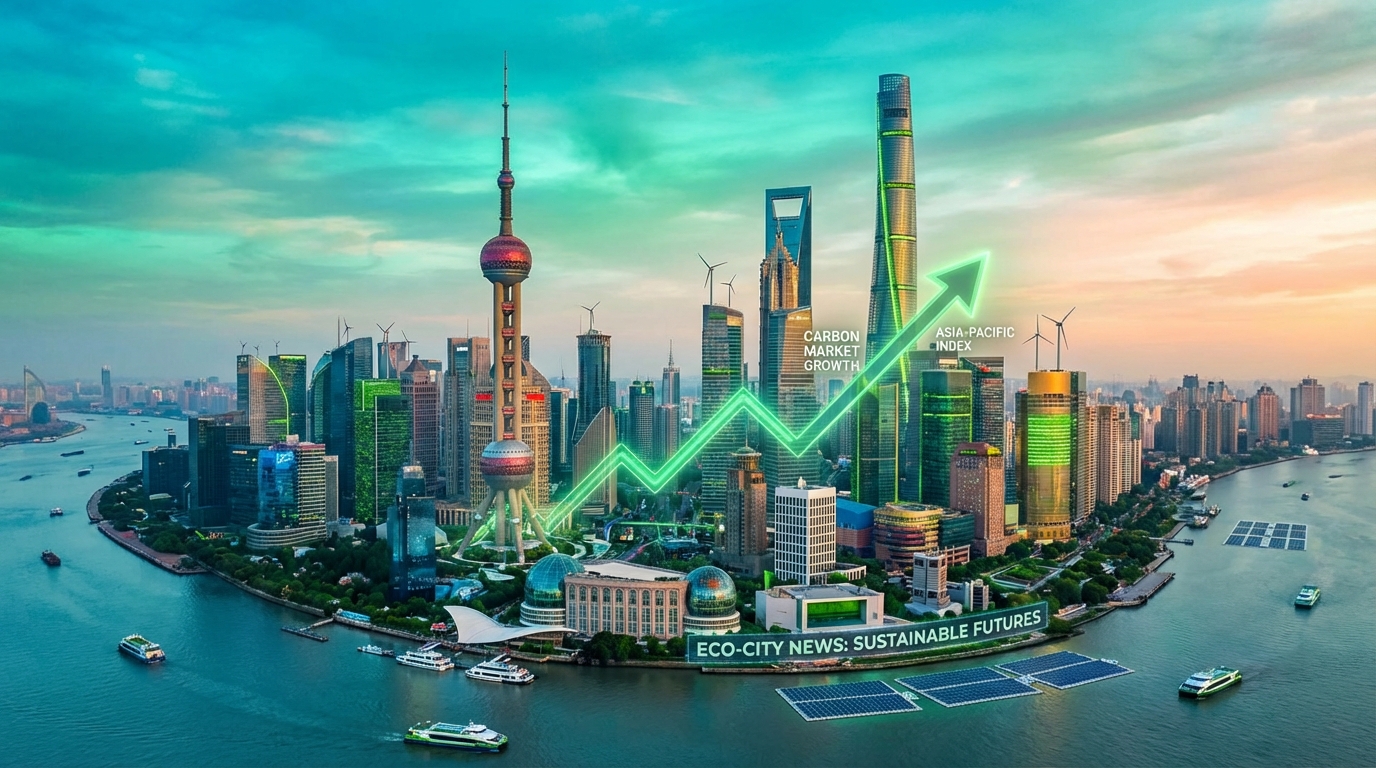
While Western markets debate policy and wrestle with political headwinds, Asia-Pacific is quietly building the future of carbon trading.
The numbers tell an unmistakable story. Asia-Pacific voluntary carbon markets are projected to grow at a staggering 36% to 58% compound annual growth rate through the decade - outpacing every other geography on the planet.
Europe, long considered the spiritual home of carbon pricing, suddenly looks like yesterday's market. The center of gravity in global carbon finance is shifting east, and the implications extend far beyond regional trading statistics.
The Scale of the Shift
Consider the trajectory. The global voluntary carbon market is valued at approximately $2.52 billion in 2025, projected to reach $3.04 billion in 2026 and potentially $16.38 billion by 2035. Asia-Pacific is capturing a disproportionate share of this growth.
Multiple factors are converging:
Supply Abundance: Asia hosts many of the world's most promising carbon project categories - tropical forests, mangroves, renewable energy, and increasingly, technology-based removal projects. Countries like Indonesia, Malaysia, Vietnam, and the Philippines offer vast natural carbon sinks.
Demand Acceleration: Asian corporations are rapidly adopting climate commitments. Japanese, Korean, and increasingly Chinese companies are entering voluntary markets. India's corporate sector is awakening to ESG pressures.
Policy Tailwinds: Unlike the political volatility affecting climate policy in some Western nations, key Asian markets are steadily building carbon pricing frameworks that create stable demand signals.
China: The Elephant Awakens
China's carbon market story is complex but consequential. Its national emissions trading system, launched in 2021, is already the world's largest by covered emissions. While currently limited to the power sector, expansion plans would dramatically increase scope.
More significantly for voluntary markets, Chinese regulators are actively developing mechanisms to integrate high-quality voluntary credits into domestic compliance frameworks. This creates potential demand at unprecedented scale.
Chinese project developers are simultaneously ramping up supply. The country's reforestation efforts, renewable energy deployment, and emerging carbon capture capabilities position it as both buyer and seller in global markets.
India's Moment
India presents perhaps the most compelling growth narrative. The country's carbon credit market framework, formalized in 2023, is maturing rapidly. Major conglomerates - Reliance, Tata, Adani - have announced significant climate commitments that will require offset purchases.
India's project potential is equally significant. The country hosts extensive agroforestry opportunities, renewable energy projects, and waste management initiatives that qualify for carbon crediting. International buyers are increasingly sourcing from Indian developers.
The domestic market infrastructure is developing in parallel. The Indian Carbon Market is scheduled for full operationalization in phases, creating both compliance and voluntary trading opportunities.
Southeast Asia: Project Goldmine
Southeast Asia offers the most concentrated project opportunity in global carbon markets. Indonesia alone hosts roughly 10% of the world's remaining tropical rainforest. Its mangrove ecosystems are among the most carbon-dense on Earth.
Vietnam, Thailand, Malaysia, and the Philippines each offer distinct project categories - from renewable energy to nature-based solutions to waste management. International developers are flooding into the region.
The challenge lies in governance. Concerns about project quality, land rights, and benefit sharing have dogged some regional initiatives. But regulatory frameworks are improving, and the best projects command premium prices from quality-conscious buyers.
Japan and Korea: Demand Anchors
Northeast Asian economies represent crucial demand centers. Japan's corporate sector has deep sustainability commitments, and companies are significant voluntary credit buyers. The country's Joint Crediting Mechanism creates bilateral pathways for carbon finance.
South Korea's emissions trading system, among Asia's most developed, provides compliance demand. Corporate net-zero commitments add voluntary market participation. Samsung, Hyundai, and other conglomerates are building sophisticated carbon management strategies.
What This Means for Global Markets
The Asia-Pacific surge carries implications beyond regional statistics.
Price Discovery Shifting: As Asian markets grow, regional price dynamics will increasingly influence global benchmarks. The current dominance of European reference prices may erode.
New Players, New Rules: Asian project developers, standard setters, and trading platforms are emerging to challenge Western incumbents. Market infrastructure is being built with Asian characteristics.
Capital Flows Redirected: Climate finance that once flowed primarily through European and American institutions is finding new channels through Asian banks and development finance organizations.
Integration Acceleration: As China and India develop compliance markets, the interaction between compliance and voluntary systems will become more complex - and more consequential.
The Risks
Growth at these rates brings challenges. Quality control becomes harder as project volumes surge. Governance concerns persist in some jurisdictions. Currency volatility and political risk require careful management.
The opacity of some Asian markets also creates uncertainty. Private bilateral deals, which comprise roughly two-thirds of voluntary market transactions globally, are even more prevalent in Asia.
Yet the direction of travel is clear. Asia-Pacific is no longer a peripheral player in carbon markets - it's becoming the main event.
For companies, investors, and policymakers focused on global climate finance, the message is straightforward: Look east. The future of carbon markets is being written in languages other than English.
BarathVector Editorial Team covers global climate finance and emerging market dynamics. Follow our Climate & Environment section for ongoing Asia-Pacific carbon market analysis.