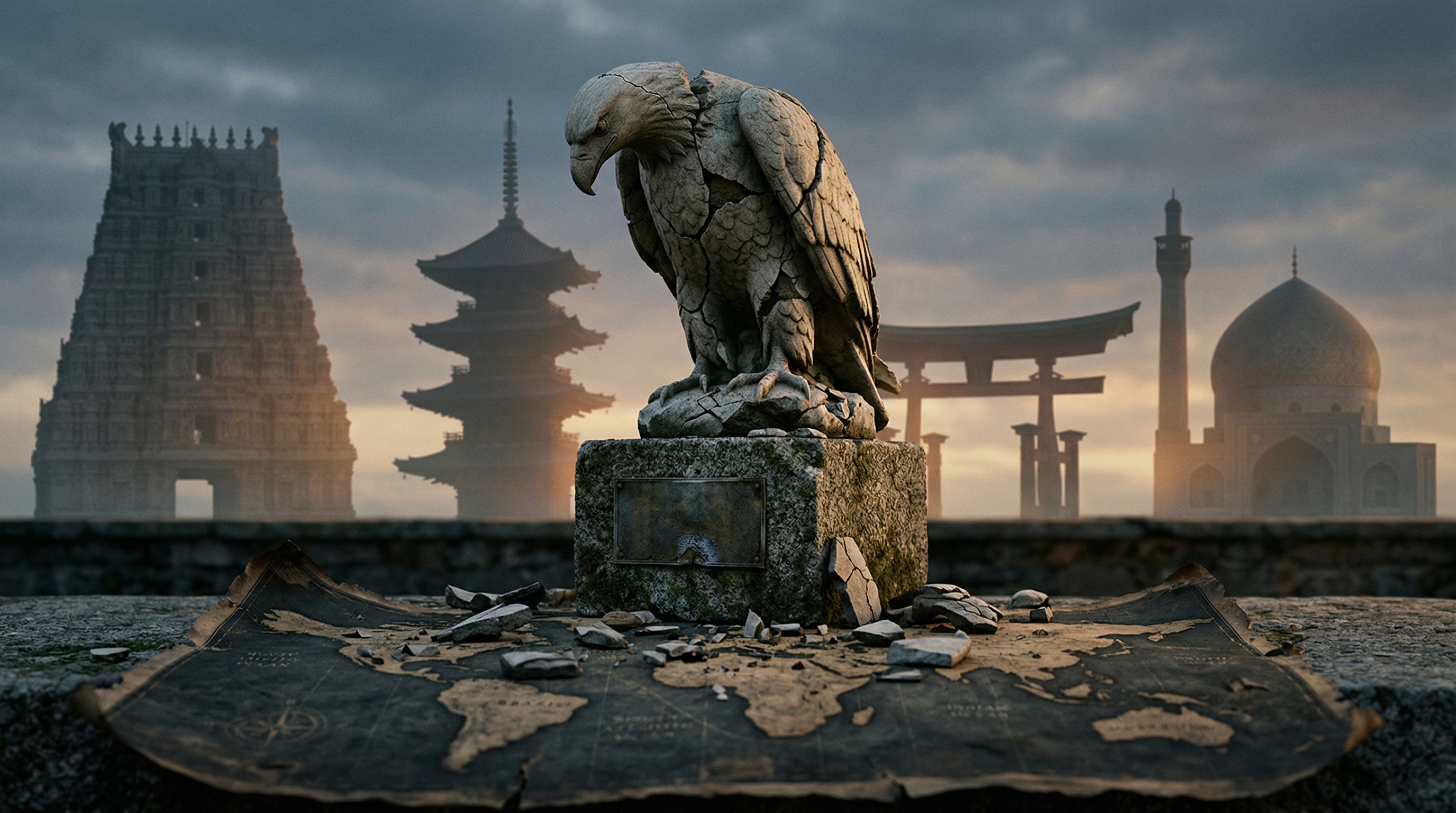
By Ramachandran Rajeev Kumar — 2026-04-10
The Art of the Deal, Unmade: How TACO Diplomacy Broke American Hegemony
Donald Trump wrote a book called The Art of the Deal. His second term has turned out to be a long annotation on that title -- a guide, written in real time, to the art of un-making one.
By Ramachandran Rajeev Kumar
There is a cruel little acronym that has become the unofficial motto of Donald Trump's second term. Traders in New York coined it first, watching a pattern emerge across tariff announcements, troop threats and summit walkouts: TACO -- Trump Always Chickens Out.
It began as a market joke. Tariffs announced on Monday, softened by Thursday, quietly rolled back by the following week. Maximum pressure on Iran, then a phone call, then a photo opportunity, then nothing. NATO will pay or NATO will be abandoned -- then a new deadline, a new number, a new face-saving formula. Every threat issued at maximum decibel. Every follow-through executed at half volume, if at all.
But what began as a trading cue has hardened into a diagnosis of American power. The most consequential office on earth is occupied by a man whose instincts are those of a dubious, short-sighted businessman: daily bluffing, perpetual narcissism, no agenda beyond asserting his own superiority, no shame when caught out. The office has not disciplined the man. The man has finally disciplined the office -- downwards.
And the price of that reduction is now being paid, in real time, by the international order the United States spent eighty years building.
From slow decline to slidestorm
American hegemony was already slipping before Trump walked back into the Oval Office. The 2008 financial crisis cracked the myth of Washington Consensus economics. The Iraq and Afghanistan interventions drained the moral authority that had survived Vietnam. The dollar's share of global reserves has been sliding for a decade, from 72 per cent in 2000 to roughly 58 per cent by late 2024 according to IMF COFER data. BRICS expansion in 2024 added Iran, the UAE, Egypt and Ethiopia. De-dollarisation was already the subject of serious, un-hysterical conversation in finance ministries from Brasilia to Jakarta.
That was the slow decline. A quarter-century glide path that might have given Washington time to manage a graceful transition to a multipolar settlement.
Trump has converted that glide into a slidestorm.
The difference is not one of policy -- policies can be reversed -- but of trust. When Washington signs a free trade agreement one quarter and re-opens it the next, the instrument stops functioning. When the President of the United States threatens his own treaty allies with abandonment, the very word ally loses its meaning. Every trading partner, every defence client, every fellow signatory to a multilateral framework is now forced to ask the question they never wanted to ask in the open: what is the United States actually good for?
Once that question is asked aloud, the answer never goes back into the box.
NATO may fire the President
The first quiet revolution is happening inside NATO. For two years, European capitals have been running a parallel exercise: what does Atlantic security look like without Washington?
The answer, embarrassingly for Trump, is not impossible. Germany's Zeitenwende defence spending has survived the change of coalition. France has accelerated its nuclear umbrella discussions with Berlin, Warsaw and Rome -- a conversation that would have been politically inconceivable in 2015. Poland has become, by raw troop numbers and defence spending ratio, the most militarised state in Europe. The United Kingdom, outside the EU but inside NATO, has quietly re-entered the continental strategic conversation at a level not seen since the early 2000s.
Trump's threats to leave NATO were meant to extract concessions. Instead, they have triggered contingency plans that now have their own momentum. European defence industrial policy is rerouting around US platforms. The F-35 debate has reopened in Berlin, in Ottawa, in The Hague. Alternative procurement pipelines -- French, Korean, Israeli, Swedish -- are being signed at a pace that would have been unthinkable three years ago.
The sharper possibility is this: Washington may not get to walk out. NATO, or a reconstituted coalition of its most serious members, may effectively continue without the United States -- not by expelling it, but by quietly routing around it. The Article 5 guarantee becomes notional. The real commitments move into European-led structures. Washington discovers, too late, that the alliance it built has learned to breathe on its own.
When an ally threatens to leave every other week, the ally being threatened eventually starts planning for the departure. That planning does not stop if the threat is withdrawn.
The Middle East monarchies discover the price of pampering
The Gulf monarchies flattered the Trump family relentlessly during the first term. Palaces were opened, deals were signed, investment vehicles were parked in real estate ventures whose beneficial ownership remains a subject for forensic accountants. The calculation was transparent: keep the erratic patron happy, preserve the security umbrella, keep the oil flowing and the weapons arriving.
That calculation is now breaking down.
The Strait of Hormuz crisis -- triggered by a combination of US brinkmanship on Iran, Houthi operations in the Red Sea, and Israeli strikes that Washington could neither endorse nor restrain -- has made Gulf oil exporters structurally nervous in a way they have not been since the tanker war of the 1980s. Insurance premiums for Hormuz transits have risen. Asian buyers have begun to rebalance their crude procurement towards Russian, African and American sources. Every barrel that finds an alternative route is a barrel that does not need the US Fifth Fleet to protect it.
The political consequence is uncomfortable for Riyadh, Abu Dhabi and Doha. The implicit contract of the last fifty years -- we price in dollars, you guarantee the sea lanes -- is now being tested by a White House that cannot decide, on any given morning, whether Iran is a partner, a pariah, or a photo op. The monarchies that pampered the Trumps may soon conclude that the family has become a liability rather than an asset. Quiet conversations are already underway about reducing the visibility of those commercial ties. When the exposure becomes politically radioactive at home, the family may find that the red carpets roll up faster than they rolled out.
The petrodollar did not collapse because China designed a trap. It began to unwind because the guarantor made himself unreliable.
Israel and the limits of the umbrella
For seventy-five years, Israel's security equation has rested on a single variable that no Israeli government has ever been able to replace: the American umbrella. Intelligence sharing, munitions resupply, carrier presence, diplomatic cover at the United Nations, and the implicit guarantee that any adversary who goes too far will eventually find itself staring at the Sixth Fleet. That architecture allowed a small state surrounded by hostile ones to practise a doctrine of disproportionate response -- to be, in the phrase of its own defence planners, the cornered predator whose first reflex is force and whose second is more force.
That doctrine worked while the umbrella was coherent. Under TACO diplomacy, the umbrella has started to flutter.
The United States has not formally withdrawn from Israel. What has withdrawn is the American capacity to play the honest broker in a region where the absence of a broker is itself catastrophic. Trump's Iran policy across two terms -- maximum pressure, walkout, strike, retreat, threat, phone call, silence -- did not break Iran. It drafted the script for a confrontation without an umpire. Every diplomatic off-ramp that previous administrations had carefully preserved has been either demolished by Trump himself or rendered inoperative by his unreliability. The Iranian debacle he has authored is not the crisis. It is the precursor.
The Gulf monarchies are trapped in a paradox they cannot publicly name. They hate Iran more than they fear Israel -- a fact the Abraham Accords made operationally visible. And yet they cannot be seen, in their own streets and their own mosques, openly supporting Israel in a shooting war with Tehran. That ambiguity is not a safety valve. It is a source of danger. It removes the quiet diplomatic lubricant -- the back-channel message from Abu Dhabi to Jerusalem urging restraint, the Saudi phone call to Washington asking for a pause, the Qatari mediation line that stayed open when every other line went dead -- that kept previous Middle East crises from escalating into regional wars. With the umbrella flapping and the lubricant dry, both predators are free to act on their worst instincts. The net result, in either direction, is excessive force.
The nuclear dimension makes this almost unbearable to contemplate. Persian civilisational depth is real, and should be respected. But civilisational depth does not guarantee theological restraint in a regime that has, for four decades, fused statecraft with eschatology. A cornered theocracy can convince itself that a first strike is not a war crime but a religious purification -- and inside that framing, the bomb ceases to be a deterrent and becomes a sacrament. Israel, for its part, will not wait to discover which framing prevails. Its entire doctrine was designed to pre-empt the scenario in which it has to find out. One weapon, in the wrong hands, at the wrong moment, is all it takes to convert a cold confrontation into a hot cataclysm.
Meanwhile, the word genocide has returned to everyday political vocabulary after an eighty-year taboo that the world fought a war to establish. It is being used by governments, at the International Court of Justice, in legislatures, on campuses, and in newsrooms that would not have touched it in 2020. The specific debates about whether any particular use is accurate are secondary to a more sobering fact: the taboo has broken. Once a word that was sacred is profaned, it is very difficult to re-sanctify. The moral ratchet turns in one direction.
This is where TACO Trump's recent civilisational wipeout rant -- a Presidential outburst in which the occupant of the Oval Office floated the erasure of entire peoples as though it were a line item in a strategic memo -- becomes not merely embarrassing but historically consequential. That a sitting American President now thinks aloud, in public, in the vocabulary of civilisational annihilation tells us more about the moral floor of the present era than a hundred think-tank white papers ever could. The taboo against speaking of extermination as policy was, until very recently, one of the quiet achievements of the post-1945 order. It has not survived contact with this presidency.
The crisis gathering in the Middle East is the kind that has always required humane, restraining, adult leadership from the world's major powers. What it has instead is a White House that thinks in grievances, a Kremlin that thinks in opportunities, a Beijing that thinks in timelines, and a collection of European capitals still learning to speak without asking Washington's permission. The single most important resource in a moment of this kind -- leadership capable of telling allies and enemies alike that is enough -- is in shorter supply than at any point since 1945.
It is worth stating this plainly, even at the risk of being called alarmist. If the current trajectory continues -- an unreliable American umbrella, a cornered Israel, a patient Iran, paralysed Gulf monarchies, absent global leadership, and a vocabulary of mass atrocity that is being rapidly normalised -- the region could enter the most brutal phase in human history since the one the world last promised itself never to repeat. The absence of humane leadership is not a soft failing of the TACO era. It is its defining danger.
India has seen the light -- and it cannot be unseen
For India, the lesson of the Trump years has been brutal and clarifying. Two decades of carefully managed strategic convergence with Washington -- the nuclear deal, the defence agreements, the Quad architecture, the semiconductor cooperation frameworks -- have collided with the discovery that none of it survives a single presidential tantrum.
Tariffs on Indian goods were announced, withdrawn, re-announced, recalibrated. Student visa regimes oscillated. H-1B rhetoric toggled between "essential talent" and "job thieves" depending on which audience was in the room. Defence procurement conversations were frozen, unfrozen, re-frozen. The one consistent message from Washington was that no message was consistent.
Delhi has drawn its conclusions. They are being executed quietly, because that is how Delhi executes conclusions. Russian oil purchases have not merely continued; they have been formalised into infrastructure -- refining contracts, payment mechanisms, insurance arrangements that route around Western strictures. The rupee-rouble-dirham triangle for trade settlement has moved from theoretical to operational. BRICS currency discussions, which India had been carefully non-committal about, are now receiving senior-level engagement.
Most importantly, the strategic doctrine has shifted. Strategic autonomy used to be a diplomatic phrase deployed for domestic consumption. It has become an operating principle. The working assumption in South Block is now that the United States is an unreliable partner whose commitments evaporate on contact with domestic politics. That assumption will not reverse when Trump leaves office. No successor, however competent, can restore trust that has been broken this publicly, this repeatedly, across this many files.
India has retreated into a defensive shell -- not of isolation, but of hedged engagement. It will trade with Washington. It will not trust it. That is a permanent adjustment, and Washington does not seem to have noticed.
Canada and the EU join the club of the disillusioned
Canada -- Canada, of all places -- has begun to talk about the United States in the tone previously reserved for adversaries. Ottawa has diversified its energy export routes. It has revived defence procurement conversations with France and South Korea. The 51st-state jokes from Mar-a-Lago, initially met with laughter, are no longer being laughed at. They are being filed.
The European Union has quietly accelerated its strategic autonomy agenda from rhetoric to budget lines. The Critical Raw Materials Act, the Chips Act, the Net-Zero Industry Act -- all three have been refitted with provisions designed specifically to reduce dependence on American supply chains and American goodwill. Brussels has stopped drafting its trade positions around preserving the transatlantic relationship. It is drafting them around protecting the single market from it.
None of these countries wanted this outcome. All of them tried, through the first Trump term, to treat his presidency as an aberration to be weathered. The second term has ended that illusion. The damage is not a bug in the operating system. It is the operating system.
Trump's best friends
Examine the short list of world leaders who have prospered in Trump's orbit and a picture emerges that is almost comic in its clarity. The friendship with Islamabad has deepened, despite Pakistan's economic collapse and ongoing proxy problems, because Islamabad offers flattery on demand and tolerates the grift. Crypto promoters and casino operators have become regular fixtures at the properties. A rotating cast of unsavoury intermediaries -- men whose business cards describe them as "advisers" without specifying to whom -- have become the informal channel for foreign governments who cannot get a serious meeting through normal diplomatic processes.
This is not a coalition. It is a court. And courts produce courtiers, not allies.
The beneficiaries of this arrangement are obvious. China has not had to do anything dramatic to advance its interests during the Trump years; it has simply had to refrain from major mistakes while Washington made them for it. The Belt and Road Initiative, dismissed as faltering in 2022, has been quietly reconstituted with new partners -- including, increasingly, partners who used to be solidly in the American camp. Beijing's diplomatic posture has become conspicuously adult: patient, forward-planning, technocratic. The contrast with Washington's daily circus writes its own editorial.
Russia is next in line. Sanctions-fatigue has set in across the European political class. Backchannels have multiplied. The working assumption in Moscow is that a second Trump term will not meaningfully contain Russian revisionism in its near abroad, and Moscow is behaving accordingly -- consolidating in Belarus, deepening ties with Iran, formalising trilateral arrangements with China and North Korea that would have been unthinkable a decade ago.
These are not victories China and Russia engineered. They are gifts delivered by an American president who thinks in days, not decades.
The awakening of ancient civilisations
There is a harder, more interesting dimension to this moment, and it is where the story turns from diagnosis into something closer to prophecy.
The collapse of American hegemony is not producing a vacuum. It is producing a return. Civilisations that spent two centuries accepting the framing of themselves as developing or emerging or recovering are beginning to remember, out loud, that they are older than the concept of the West and were continental-scale organising principles when Washington was a swamp.
India has begun to articulate a civilisational self-understanding that goes beyond the postcolonial framing. The G20 presidency, the Amritkaal doctrine, the digital public infrastructure exports, the cultural diplomacy around yoga and Ayurveda and Sanatana themes -- these are no longer ornamental. They are organising principles for a country that has decided it has its own answers and does not need to borrow them.
Japan is shedding the pacifist self-image imposed on it after 1945. Defence spending is rising towards two per cent of GDP for the first time since the occupation. The alliance with Washington remains, but the subordination in it has thinned. Tokyo has started signing defence and technology agreements with countries it used to approach only through the American filter -- India, Australia, the Philippines, Vietnam. The Japanese political class has quietly begun to ask whether Tokyo should plan for a world in which Taiwan is defended by a coalition that does not include the United States. That question, asked in Tokyo, is seismic.
China needs no introduction in this context. Beijing's own civilisational reassertion has been the dominant geopolitical fact of the last fifteen years. What is new is that the American counter-narrative has collapsed into incoherence, which means the Chinese version of the twenty-first century -- multipolar, continental, state-led, civilisationally confident -- is increasingly the only coherent version on offer.
Russia belongs in this list too, though its entry is the most complicated of the five. Sanctions relief, backchannels, and strategic gains from Washington's incoherence are the short-term story, rehearsed earlier in this essay. Beneath them sits a much older thread. The Muscovite-Romanov-Soviet-Federation line is a single civilisational arc -- Orthodox in its spine, imperial in its instinct, Eurasian in its self-understanding -- and one of the oldest continuous state traditions on the Eurasian landmass. The Third Rome claim was never just Kremlin rhetoric; it was a theory of civilisational continuity that Russia has been articulating, in one vocabulary or another, for six centuries. Tolstoy and Dostoevsky were not regional novelists. They were the literary front of a civilisation that has always insisted it was neither East nor West, but something older and larger than either.
The current moment has pushed that older claim back to the surface. The Russkiy Mir doctrine, the Eurasianist revival, the Orthodox re-confessionalisation of public life, the strategic pivot to China, India and Iran -- these are not merely the reflexes of a sanctioned pariah. They are the resurfacing of a civilisational self-understanding that Soviet internationalism had boxed up, and that the collapse of the West's moral monopoly has now let out of the box. The painful complication, and it must be named plainly, is that this reassertion is being pursued through a war whose human cost disfigures the case it tries to make. A civilisation returning to itself does not need to flatten a neighbour to prove the point. Russia's place in the multipolar settlement will depend, in the long run, on how much of that story it is willing to tell itself honestly.
And then, most surprisingly of all, Persia. Iran is a pariah regime by the conventional reckoning. It is also the inheritor of one of the oldest continuous state traditions on earth, and it has spent the last four decades demonstrating strategic patience that its opponents consistently underestimate. The Hormuz crisis, intended by Washington to break Iran, has instead broken the American brand in the Gulf. Tehran's ten-point proposals, its diplomatic overtures to Delhi and Beijing, its quiet management of the Axis of Resistance -- these are the moves of a civilisation that has decided its moment is arriving, and that it will be there when it does.
This is precisely the outcome the progressive Gulf monarchies feared most. A resurgent Persia, with Chinese capital, Indian oil demand, Russian weapons, and a discredited American security umbrella across the water. The irony is that it was Washington's incoherence, not Tehran's cunning, that produced the opening.
The sunset and the long dawn
The cruellest joke of the TACO era is that the man who wrote The Art of the Deal has ended up demonstrating, in painful detail, the exact inverse of the thesis. Deals require credibility. Credibility requires consistency. Consistency requires, at minimum, a sense of shame when caught bluffing. Trump has removed all three from the American repertoire, and the repertoire has shrunk accordingly.
Empires rarely fall to an enemy. They fall because the centre stops holding its own promises. The British Empire did not end because of German or Japanese force; it ended because Britain stopped believing in its own story. The Soviet Union did not collapse because of Reagan's speeches; it collapsed because the men running it stopped believing in the project. The American order is not ending because China has built better aircraft carriers. It is ending because the President of the United States believes nothing in particular and has no shame about saying so.
The path ahead is not a clean transition to a new hegemon. China will not replace the United States one-for-one; it does not want to, and would not be allowed to. What is emerging instead is a world of civilisational blocs -- India, China, Japan, Russia, Persia, a reconstituted Europe, a fragmented Americas -- each with its own currency arrangements, its own security understandings, its own technological stacks, and its own civilisational self-story. The single integrating frame is gone. What replaces it will be messier, more dangerous in some respects, more honest in others.
For India, the task is to navigate that world without illusions about any partner, including the United States -- especially the United States. For the Gulf monarchies, it is to decide, quickly, whose client they wish to be in the next cycle. For Europe, it is to finish the adult conversation about continental security that Washington forced it to start. For Japan, it is to stop waiting for permission. For Persia, it is to convert patience into position. For Russia, it is to decide whether the civilisational return can survive the methods being used to claim it. For China, it is to avoid the imperial overreach that destroyed the last two global orders.
And for the United States? The hardest adjustment of all. The realisation that the office of the President is no longer the office of the world's most important man, because the world has been paying attention, and the world has decided.
The art of the deal was always a kind of bluff. TACO diplomacy has finally called it.